Daily Shaarli

What is TDD?
TDD stands for Test Driven Development. The process is simple:
- Before you write implementation code, write some code that proves that the implementation works or fails. Watch the test fail before moving to the next step (this is how we know that a passing test is not a false positive — how we test our tests).
- Write the implementation code and watch the test pass.
- Refactor if needed. You should feel confident refactoring your code now that you have a test to tell you if you’ve broken something.

Google Fonts are easy to implement, but they can have a big impact on your page load times. Let’s explore how we can load them in the most optimal way.


“[…] never solve the problem I am asked to solve. […] Because, invariably, the problem I am asked to solve is not the real, fundamental, root problem.” — Don Norman in The Design of Everyday Things
When we finally shipped the feature, however, we realized that filters weren’t what users wanted at all. They wanted something much more basic: content that was relevant to their unique situation, with the minimal number of steps required to get it. Giving our users what they wanted taught us this lesson the hard way.
Create animation magic using keyframes, animation properties like timing, delay, play state, animation-count, iteration count, direction, fill mode and will-change.
As a designer, I love coming across fun animations when visiting a site, and I have definitely been seeing more and more of them lately. Animations take illustrations and icons to the next level, making a site that much more engaging. While they are obviously attractive to look at, they also serve a functional purpose, captivating visitors and encouraging them to interact with the content.

Not everyone is aware that make can easily be used to manage tasks in your projects. In this article, I’d like to share a brief introduction to how Makefiles help me automate some tasks in my day to day activities. This brief guide will focus on using make as an automation tool for tasks rather than a tool for compiling code.
You should draw.
Sometimes a problem seems too big or too abstract to fit into a neatly formatted list of requirements. It’s difficult to hold and pick apart a series of steps in your head. You want to connect ideas, follow many series of steps in different directions, while also considering constraints and stress cases. But your brain wants to follow one train of thought from beginning to end. Anything that looks like it’ll take you off track gets brushed aside, “We’ll come back to it.” You end up in a battle with your own mental capacity. You need to explore all sides of a problem while simultaneously looking for weak points. There comes a real concern of things slipping through the cracks because your brain can’t hold them all or remember them for long.
Visualizing problems on a canvas gets them out of your head and into the real world. You can put all the pieces in front of you so you — and everyone else — knows what you’re working with. Every time a new idea, challenge, or path comes up, make a note. You may not solve it at the same time, but it’s there, waiting until you’re ready. This frees up mental space to start challenging your ideas and working towards solutions that include everyone — instead of barrelling down one track to the obvious, happy-path conclusion.
Your team should draw.
Because whiteboards are part of our physical space, they can be gathering places. We sit together with our teams, but each facing our own personal, digital canvases: our monitors. Work is only shared when you as an individual feel it’s ready, or a colleague has asked you to share. When we work at the whiteboard, we share our work while we work .
Everyone should draw.
The whiteboard is not a canvas for designers, it’s a canvas for discussion.
We build a simple, but powerful and intuitive, model for when a hockey coach should pull the goalie when trailing. When the model reports that the coaches aren’t doing it nearly early enough, we then ask why, and take away some key lessons for portfolio and risk management, and business in general.
Our brains are designed to worry, and they’re good at it.
They’re built to determine the next big thing to “fix.”
We were born to survive, which is to create.
Suffering dissolves when we focus on creating rather than feeling. Instead of being at the whim of how the world makes us feel, we focus on how we can create what we want from what exists.
Good and bad become irrelevant when the focus isn’t “What can I enjoy?” But, rather, “What can I create?”
To do something well you have to like it. That idea is not exactly novel. We've got it down to four words: "Do what you love." But it's not enough just to tell people that. Doing what you love is complicated.
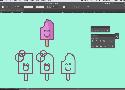
After one week of pen-tooling mazes, I never had any difficulties with the instrument again. If I could shout one thing from the rooftops to beginning illustrators, it would be to conquer mazes.
I started looking at the components it would take to rebuild—a circle for this, a modified rectangle for that. With the exception of some unique paths here or there, almost every part stemmed from the simple shapes we learn in kindergarten.
In fact, it actually turns out that most flat illustrations are either based upon these basic shapes (which Illustrator perfectly pre-sets), or an organic shape (for which the mazes serve as preparation).
-
Say it three times
Rather, the first time serves as a primer, the second as confirmation, and the third as a reminder. -
Mean (and do) what you say
If you can’t stand behind your statements or answers at work, repeating them will be both hard to do and misleading for the listener. -
Remember that real love has real boundaries
So often frustrations arise when a decision seems arbitrary or contradictory. -
Expect change regularly
But if we can accept that most things at work will change at some point, and account for that in our plans, we’ll be able to better recover and face new realities with perspective. -
Provide a soft landing for transitions
No amount of self-awareness can stop the emotions my daughter — and all of us — feel around transitions.
We should be gentle with ourselves during these moments, recognizing that our emotions are legitimate and normal.
We should extend the same generosity to our colleagues, whether or not they acknowledge they’re having a difficult time.
Let’s take a deep breath together

Injuries to the musculoskeletal system come in two basic types: acute traumatic and chronic overuse.
In chronic overuse injuries, however, inflammation may not actually play a significant role, which may explain why NSAIDs in that setting, while often useful for reducing pain, are often unhelpful in actually healing the injury itself.
The main therapeutic treatment I apply to most musculoskeletal injuries, whether acute or chronic, is the simplest: rest.
NSAIDs provide two independent effects: pain relief and reduction in inflammation. However, these two benefits occur at different dosages. For example, ibuprofen can provide pain relief at just 400 mg/day but only at 1800 mg/day does it provide an anti-inflammatory effect.
You’re asking the wrong question.
“What process can we come up with so that we are creating something new, every single day?”
Content creation is about Volume. Plain and simple.
“Almost everybody I know who does interesting, creative work went through a phase of years of where they could tell that what they were making wasn’t good as they wanted it to be… It is only by going through a volume of work will you close that gap, and your work will be as good as your ambitions” — Ira Glass
Every month I reflect on ‘How I can be a better Designer’. I learned through my background in visual arts that you can train yourself to draw better in a shorter period of time (literally).
I experimented with this in the Summer of 2013. My goal then was to achieve realistic sketches of eyes that captured human emotion. To do this I gave myself a 30-minute time limit and these were the results…
1) 8–6–4–2 Rapid Prototype Method
The premise of this method is to sketch for 8 minutes, 6 minutes, 4 minutes and 2 minutes with quick 2 minute feedback sessions in between.
2) A Twist on the #DailyUI Challenge
Maybe you’re like me and you’ve received the congratulatory email on Day 100 🎉 with nothing to show for it. This was the simple twist I added to get myself started.
3) Solve a Problem you’ve encountered
Take a moment in your day-to-day to note down real world problems that you wish there were better solutions for. You might already a list or two or five. It’s time to solve that problem.