Daily Shaarli

Allulose is on the top of my sweetener preference list for both objective and subjective reasons.
Although allulose is not as sweet as sugar, I have found that when my daughter bakes with a 1:1 replacement ratio as called upon by recipes, it is still plenty sweet. In short, allulose provides a reasonable amount of sweetness for my family. One aesthetic caveat is that allulose browns in the baking process so it is best used for darker-colored goods…unless you are like me and don’t mind a brown-colored angel food cake.

A lot of people think of creativity and discipline as opposites. But nothing could further from the truth… Many of the most creative people the world has ever known were surprisingly disciplined in…
- Outline your creative work the day before
- Create a warm-up ritual
- Stop fighting your procrastination and validate it instead
- Quarantine your busywork

Design is problem solving
In a previous essay, I visualized it like this:
By focussing on the thinking part of design, design could move into a broader problem solving space. Hence the statement that design is problem solving. It is. Design solves design problems.
Design is making the world more beautiful
Design is question finding
But design is even more than problem solving and making the world more beautiful.
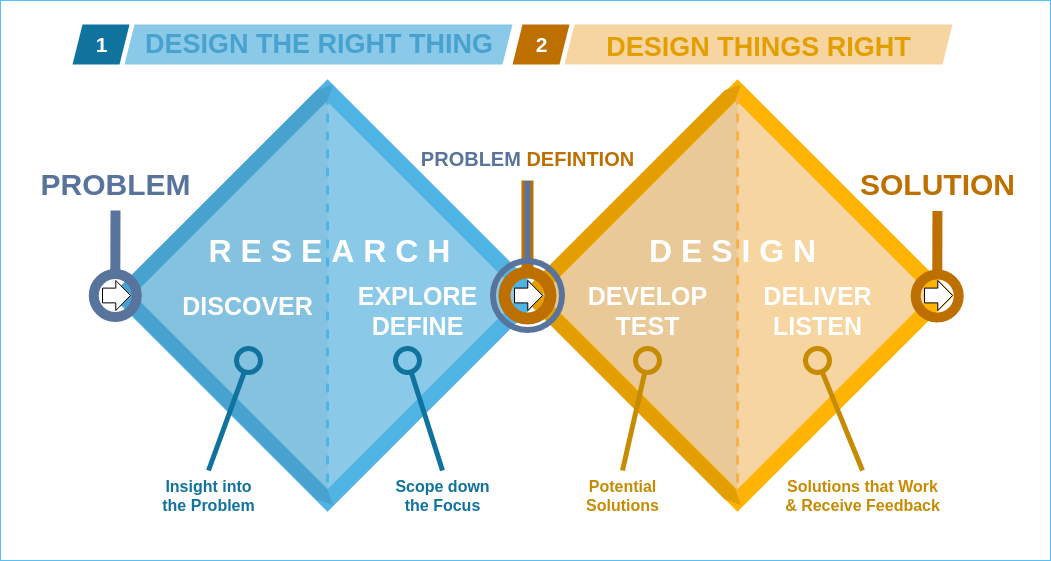
Most people see design as just the second diamond: problem solving. Most clients approach a designer with a problem definition a.k.a. a design brief. They already know what the problem is and w(previous essay)ant a (team of) designer(s) to solve it for them. If that is actually the right problem, great. Experience tells us that that is not always the case. More often than not, new insights about the problem at hand arise during the solving of the problem. That is why designers often propose to go into the first diamond first to investigate the problem and possibly redefine the problem. This prevents them from designing a brilliant solution for the wrong problem. That can be very expensive. The goal of the first diamond is to make sure we are solving the right problem, find the right question. Most innovations and complex problems benefit hugely from going through the first diamond. In his recent Harvard Business Review article, Art Markman argues that the quality of our problem framing determines the success of your solution.

Choosing good colors for your charts is hard. This article tries to make it easier.
01 Broaden your understanding of colors
02 Don’t dance all over the color wheel
03 Use saturation and lightness to make your hues work
04 Use warm colors & blue
05 When using green, make it a yellow or blue one
06 Avoid pure colors
07 Avoid bright, saturated colors
08 Combine colors with different lightness
09 Make your colors similarly “colorful”
10 Avoid too little contrast to the background
11 Avoid too much contrast to the background
12 Choose a background that’s desaturated enough
13 Copy colors, or understand them
In this modern era of web development, we don’t really need a heavy-handed reset, or even a reset at all, because CSS browser compatibility issues are much less likely than they were in the old IE 6 days. That era was when resets such as normalize.css came about and saved us all heaps of hell. Those days are gone now and we can trust our browsers to behave more, so I think resets like that are probably mostly redundant.


In the three-minute video, he walks viewers through his steps to make the classic cocktail, which requires some ice, a double shot of gin (or vodka), a shot of sweet vermouth, and a shot of Campari. He also throws some shade on Martini brand vermouth. Sorry, friends. Oh, and the pièce de résistance is a quick squeeze of an orange that also acts as a garnish. Like any responsible chef, he takes a sip to test the drink before turning it over.

This lemon poppy seed quick bread is moist, flavorful, and speckled with plenty of poppy seeds. Finish it with a light layer of lemon glaze.

Here's a collection of 20 astounding hacks that'll help make your marking more accurate and your days more productive.
- Tack Trim in Place While Marking
- Don’t Trust Factory Edges
- Use a compass for scribing
- Circles (with a speed square and nail)
- Flashlight as plumb bob!
- Isometric graph paper